Most teams treating themselves as “AI-augmented” have added a code assistant to the IDE and called it done. The productivity gains are real but narrow: a faster first draft, fewer boilerplate lines. The structural problems in software delivery, ambiguous requirements, shallow test coverage, reactive incident response, documentation that lags the codebase, remain untouched.
Eastern Enterprise engineers are trained to work AI-natively, meaning AI is a participant at every phase of delivery, not a finishing tool applied at the end. We apply it where the highest-cost mistakes originate, in requirements before development starts, and where the highest-cost failures occur, in production after deployment. The result is a delivery process that is faster, more predictable, and measurably better at finding and preventing defects early. Not because we have better AI tools, but because our engineers know when and how to use them.
Requirements failures are the most expensive problems in software delivery and the easiest to avoid, if caught early. Vague acceptance criteria, missing edge cases, undiscovered conflicts between stakeholder inputs, and architecture decisions made under time pressure all introduce technical debt before a line of code is written. The later these issues are found, the more they cost: a requirements gap caught in planning is a conversation; the same gap caught in UAT is a sprint of rework.
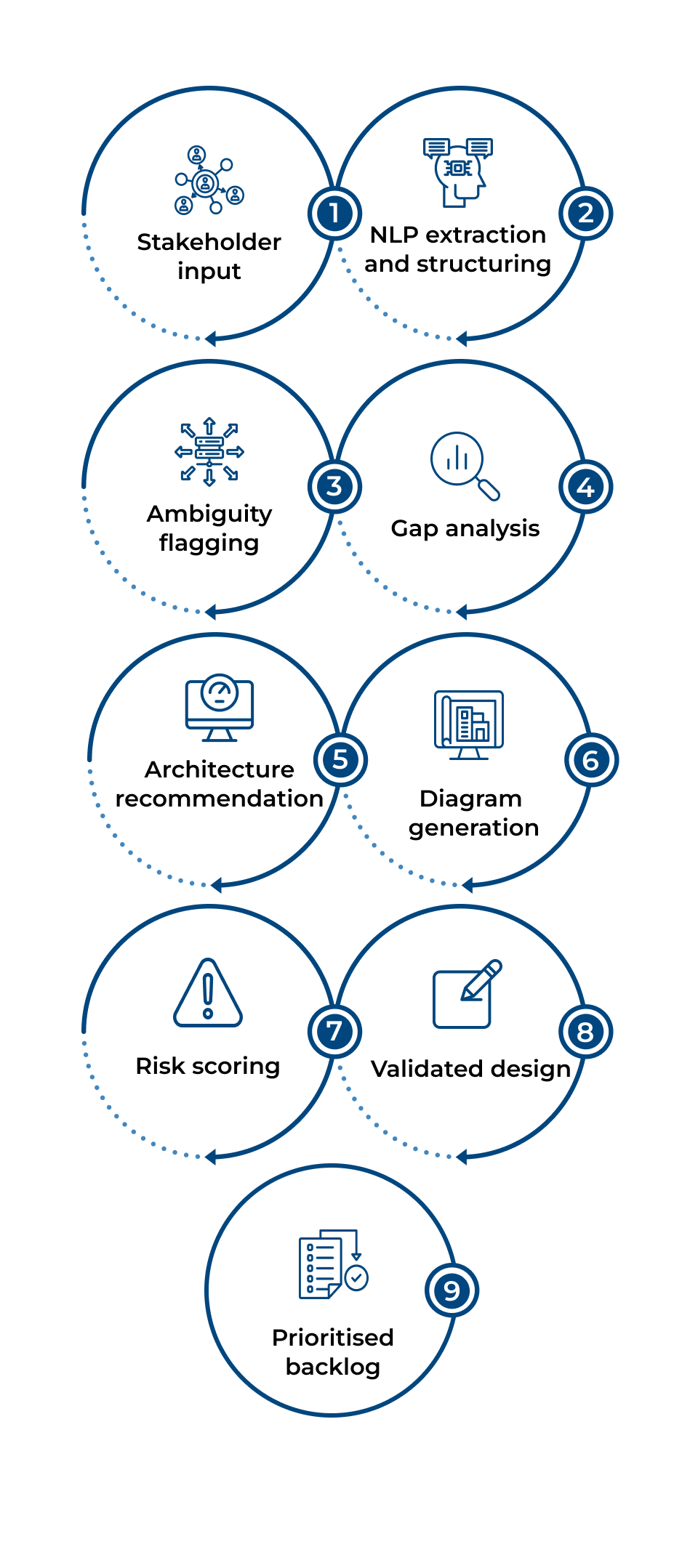
We use AI to extract, structure, and stress-test requirements from stakeholder inputs, meeting notes, existing documentation, and tickets even before the backlog is committed. Acceptance criteria are generated from user stories. Edge cases and failure modes are surfaced systematically, not left to individual reviewers. Architecture decisions benefit from the same treatment: pattern suggestions, anti-pattern detection, and diagram generation from plain-English descriptions that compress days of design work into hours
NLP-based requirement extraction from documents, meetings, and tickets that are structured and de-duplicated
Ambiguity detection and gap analysis before backlog sign-off
Acceptance criteria and edge case generation directly from user stories
AI-suggested architecture patterns with explicit anti-pattern identification
ERD, sequence diagram, and flow generation from plain-English descriptions
Tools: Claude, ChatGPT, Eraser.io, Mermaid AI, Notion AI

Engineering teams spend a large proportion of their time on work that is necessary but not inherently difficult: code review, test case creation, documentation maintenance. The problem isn't that this work exists, it's that when done manually, it's inconsistent. Code review depth varies by reviewer and time pressure. Test suites trail the codebase. Documentation becomes inaccurate within weeks. Defects that a more thorough process would catch early arrive instead in QA or, worse, in production.
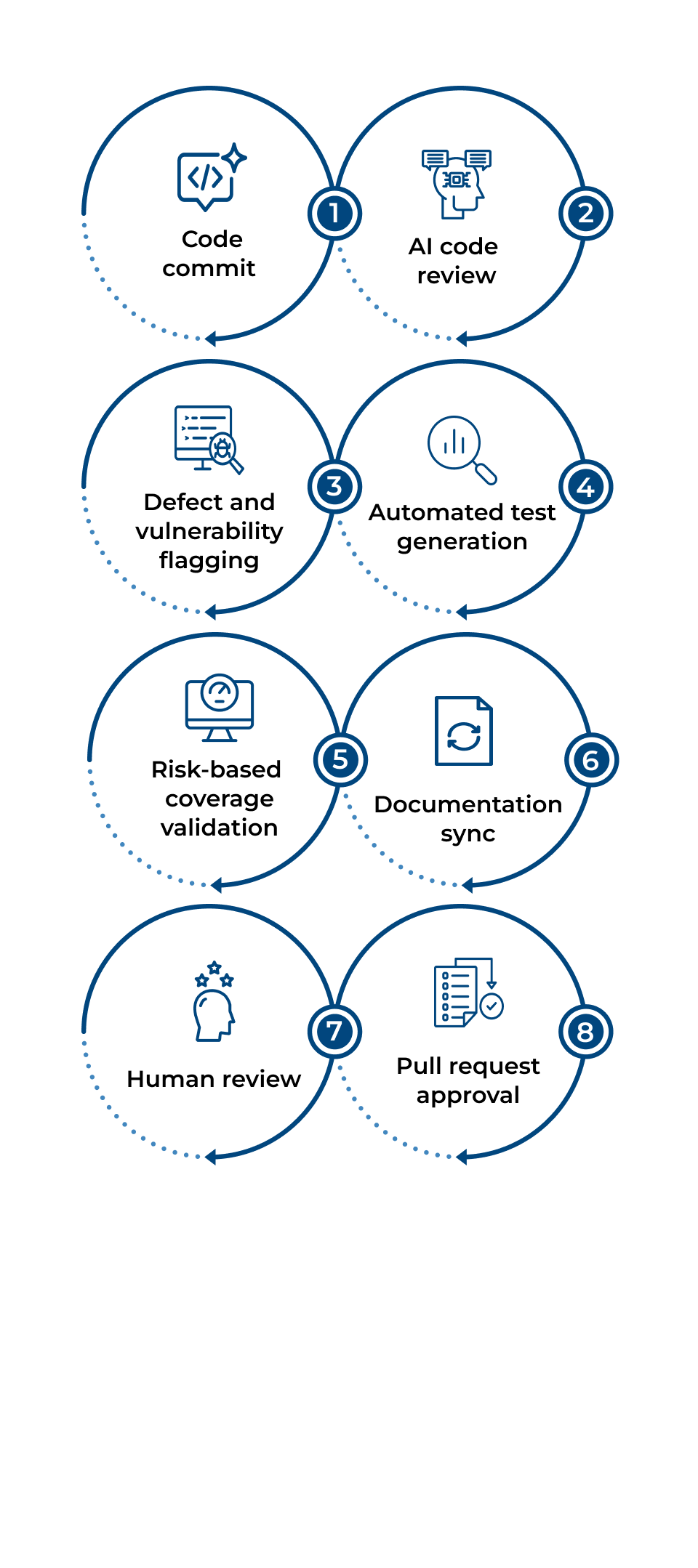
We embed AI into the development workflow so that every pull request receives consistent, automated review for logic errors, security vulnerabilities, and style violations before a human reviewer sees it. Test suites are generated directly from source code and requirements, with risk-based prioritisation to ensure coverage is focused where defect likelihood is highest. Documentation is auto-generated and kept in sync with the codebase which is not a quarterly task, but a live artifact updated continuously.
AI pair programming embedded in the IDE across all active development
Automated code review on every pull request: logic errors, security issues, style violations
Automated unit, integration, and edge-case test suite generation from code and requirements
Risk-based test prioritisation: coverage focused on highest-defect-probability areas first
Auto-generated living documentation: API references, architecture decision records, runbooks
Tools: Cursor, GitHub Copilot, CodiumAI, Diffblue, Mintlify, Swimm

Production incidents are the most expensive problems in software delivery, and the most preventable. Teams running manual monitoring and reactive incident response consistently miss emerging failures until they become user-visible outages. By the time an alert fires, the issue has often been developing for hours. The cost isn't only in resolution time, it's in the confidence lost across the delivery team, the leadership pressure that follows, and the delayed releases that come after.
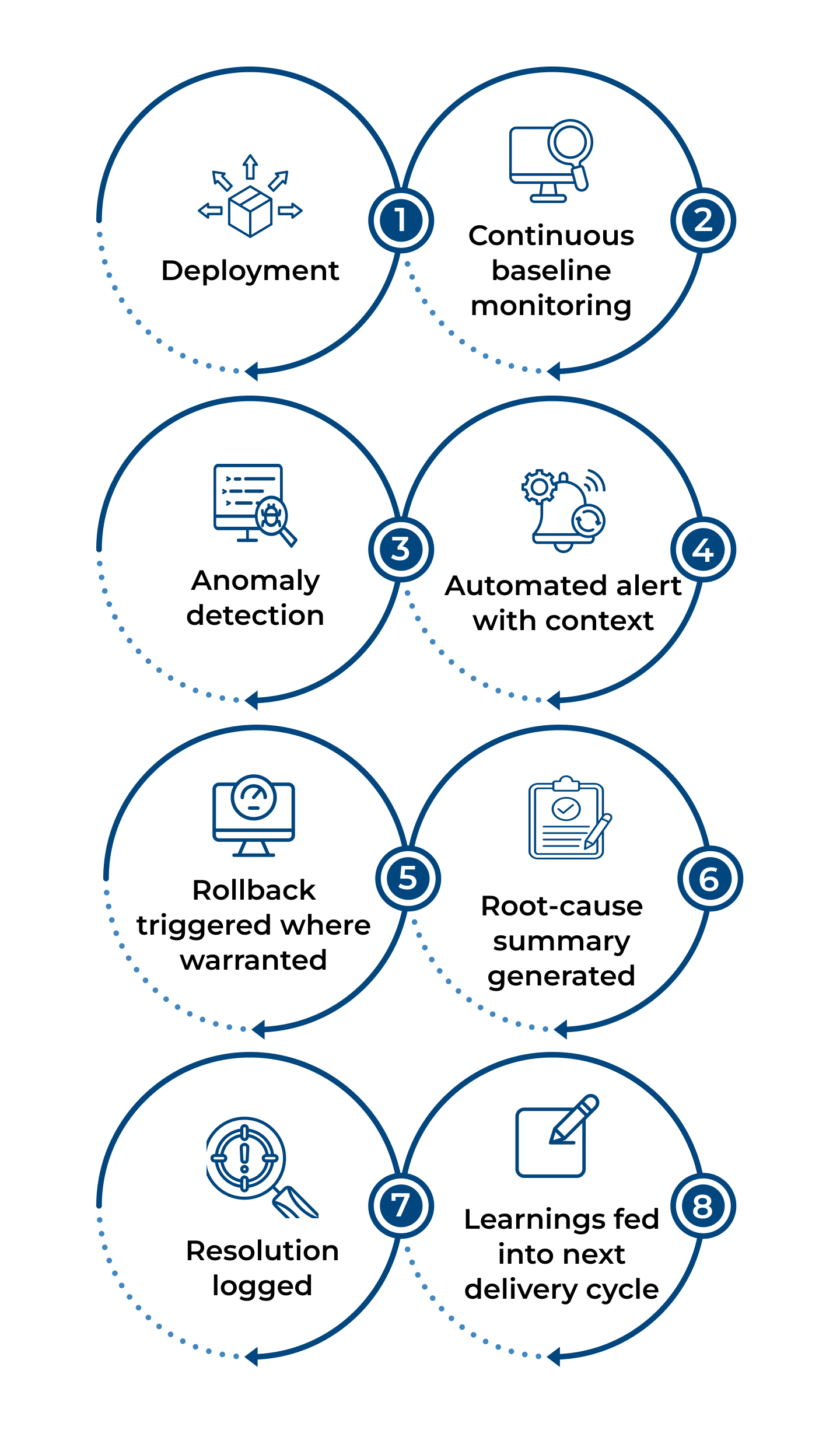
We embed AI into the deployment and production monitoring pipeline to catch what threshold-based alerts miss: early anomaly patterns, performance degradation signals, and correlated failures across services. Incidents are summarised automatically with initial root-cause hypotheses attached. Rollbacks are triggered on live performance signals where warranted. Engineering teams spend their time resolving issues, not hunting for them.
AI anomaly detection trained on service baselines catches deviations before users are affected
Predictive alerting with noise filtering: fewer false positives, faster response to real events
Incident summarisation with AI-generated root-cause analysis on failure events
Automated rollback triggers based on live performance signals, not manual thresholds
Integrated into existing monitoring stacks with no rip-and-replace
Tools: Datadog AI, Grafana, PagerDuty AI

© 2025 Eastern Enterprise. All rights reserved.