
For most of the past decade, digital transformation rewarded commitment. Enterprises selected an ERP, a cloud provider or a CRM and built around it for years because switching was slow and costly.
AI models do not follow that pattern. They are retired, repriced and superseded far more frequently than the platforms beneath them. They can also become unavailable for reasons outside a customer’s control. An enterprise that connects every AI agent directly to one model has reintroduced the single point of failure that cloud architecture was designed to remove.
The architectural answer is model flexibility: the ability to change AI models without rebuilding the applications, business logic and infrastructure that depend on them. For 2027, enterprises need to treat the model as a supplier rather than a foundation, and design their enterprise AI architecture so that the supplier can be changed.
Model Change Is Now Routine
The evidence from the past year is consistent. AI providers are retiring models on increasingly short cycles. Anthropic retired Claude Sonnet 4 and Opus 4 roughly thirteen months after their release, while OpenAI ended API access to GPT-4o around three months after announcing the change.
Retirement can also change the economics of an AI workload. When Claude 3 Haiku was retired, its suggested replacement carried an output price roughly four times higher. Workloads that were previously economical became materially more expensive without any change in scope.
Availability is not guaranteed either. Earlier this year, Anthropic suspended access to two of its models for about three weeks to comply with US export controls. No amount of engineering on the customer side could have prevented that.
Market leadership is shifting just as quickly. Menlo Ventures data shows OpenAI’s share of enterprise LLM usage falling from 50% in 2023 to 25% by mid-2025, while Anthropic’s rose from 12% to 32%. The strongest model for a particular use case today may not be the strongest next year.
Large enterprises are responding. An a16z survey of 100 Global 2000 CIOs found that 81% now use three or more model families, up from 68% a year earlier. Gartner has also included Sovereign Tech among its strategic technology trends for 2027, reflecting the growing importance of being able to move away from critical technology providers.
Why Single-Model Architectures Break
Single-model architectures rarely fail at launch. The cost appears when the model changes, and it tends to concentrate in four areas.
Prompt dependence: Prompts tuned to one model’s behaviour seldom transfer cleanly to another. A model change therefore becomes a rewrite rather than a configuration change.
No objective basis for comparison: Without an evaluation set built from the organisation’s own cases, there is no reliable way to establish whether a replacement model performs better or worse.
Direct provider integration: When individual services call a provider’s SDK directly, changing models affects every connected service and becomes a project in its own right.
Business knowledge held on vendor platforms: Rules, tools and memory built using proprietary provider features cannot easily be moved to another platform.
Contractual protection is limited, too. Anthropic, for example, commits to at least 60 days’ notice before retiring a public model. That may be reasonable from a provider’s perspective, but it is short relative to most enterprise testing and approval cycles.
The common issue is architectural dependency. If prompts, integrations, business rules and operational controls are tied to one provider, changing the model means changing much more than the model itself.
Designing an AI Architecture That Can Change Models
The organisations best prepared for 2027 will rent the model and own the layers around it. A model change should become a controlled decision rather than a rebuild.
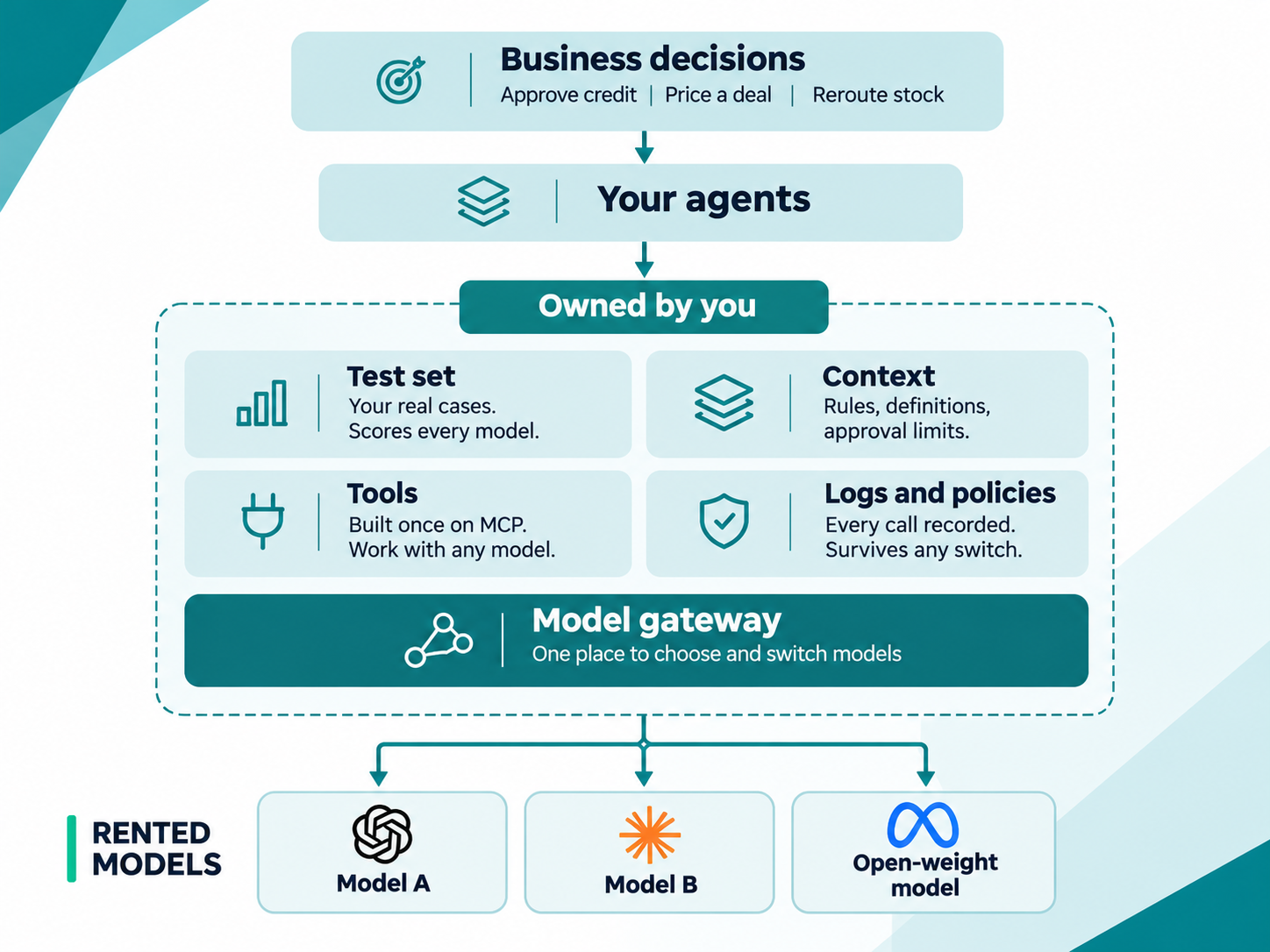
The layers in the organisation-owned part of the architecture stay in place when a model is replaced. Only the connections to the models underneath change. In practice, this requires five capabilities:
- An evaluation set built from real cases. Use historical credit files, support tickets or other business cases with known outcomes. Score every candidate model against this set before production deployment. This makes the decision to switch measurable rather than subjective.
- A context layer outside the prompt. Keep business rules, definitions and approval limits in a managed context layer instead of embedding them in provider-specific prompts. Gartner expects organisations that prioritise semantics in AI-ready data to improve agentic AI accuracy by up to 80% and reduce costs by up to 60% by 2027.
- Tool integrations built on open standards. The Model Context Protocol (MCP) is now governed by the Agentic AI Foundation under the Linux Foundation, co-founded by Anthropic, Block and OpenAI. With support across ChatGPT, Claude, Gemini and Microsoft Copilot, a tool built once can serve different model families.
- A single model gateway. Route all model calls through one integration layer. Model selection then becomes a configuration choice, allowing routine tasks to use lower-cost models while complex reasoning goes to more capable ones.
- Centralised logging and policy enforcement. Keep the audit trail independent of the underlying model. This is particularly important for high-risk applications such as credit assessment, where EU AI Act obligations apply from 2 December 2027, as referenced in the EU Digital Omnibus on AI.
For every business-critical agent, a tested alternative model should be available before it is needed, not after.
The Engineering Behind a Model-Agnostic Architecture
The principles are straightforward. The value lies in the implementation, where single-model architectures often accumulate hidden dependencies.
Rather than spreading provider-specific logic across applications, enterprises need to engineer four connected capabilities.
1. Provider-independent integration
Every model should work through one internal request and response schema, translated for the relevant provider at the gateway. This prevents provider-specific parameters and message formats from spreading through application code.
Structured outputs and tool calls should also use JSON schemas, validated at the gateway before results reach business systems. This prevents downstream applications from breaking when a replacement model formats its responses differently.
Amazon Bedrock’s Converse API demonstrates this approach by providing a common call format across model families.
2. Version control and model routing
Pin dated model versions in configuration rather than relying on floating aliases. Store prompts as version-controlled artefacts, with separate variants for model families where behaviour differs. This prevents silent behaviour changes and avoids migrations that require unnecessary code releases.
Routing rules should assign each task class a primary model, a fallback model and a token budget per agent. This prevents provider outages from becoming business outages and makes cost overruns easier to identify.
3. Managed context and evaluation
Retrieve business knowledge through versioned sources and keep rules, limits and definitions in a managed semantic layer. This prevents business logic from becoming embedded in prompts that only work with one model.
Maintain a golden set of real cases with known outcomes and run it automatically as a regression gate whenever a model, prompt or context version changes. This ensures that model changes are evaluated against actual business requirements, rather than opinion.
4. Centralised observability
Capture traces for every model call, recording the requested model, the model that served the response, token usage and latency. The OpenTelemetry GenAI semantic conventions define these fields, although they remain at Development status.
Without centralised observability, decisions become difficult to trace and costs cannot be reliably attributed to individual agents or teams.
Together, these capabilities keep application logic, business context, evaluation and operational controls independent of the underlying model provider.
Switching Models Without Surprises
Changing an AI model should follow the same discipline as any other production release. A replacement should be tested, compared and introduced gradually before it becomes the primary model.
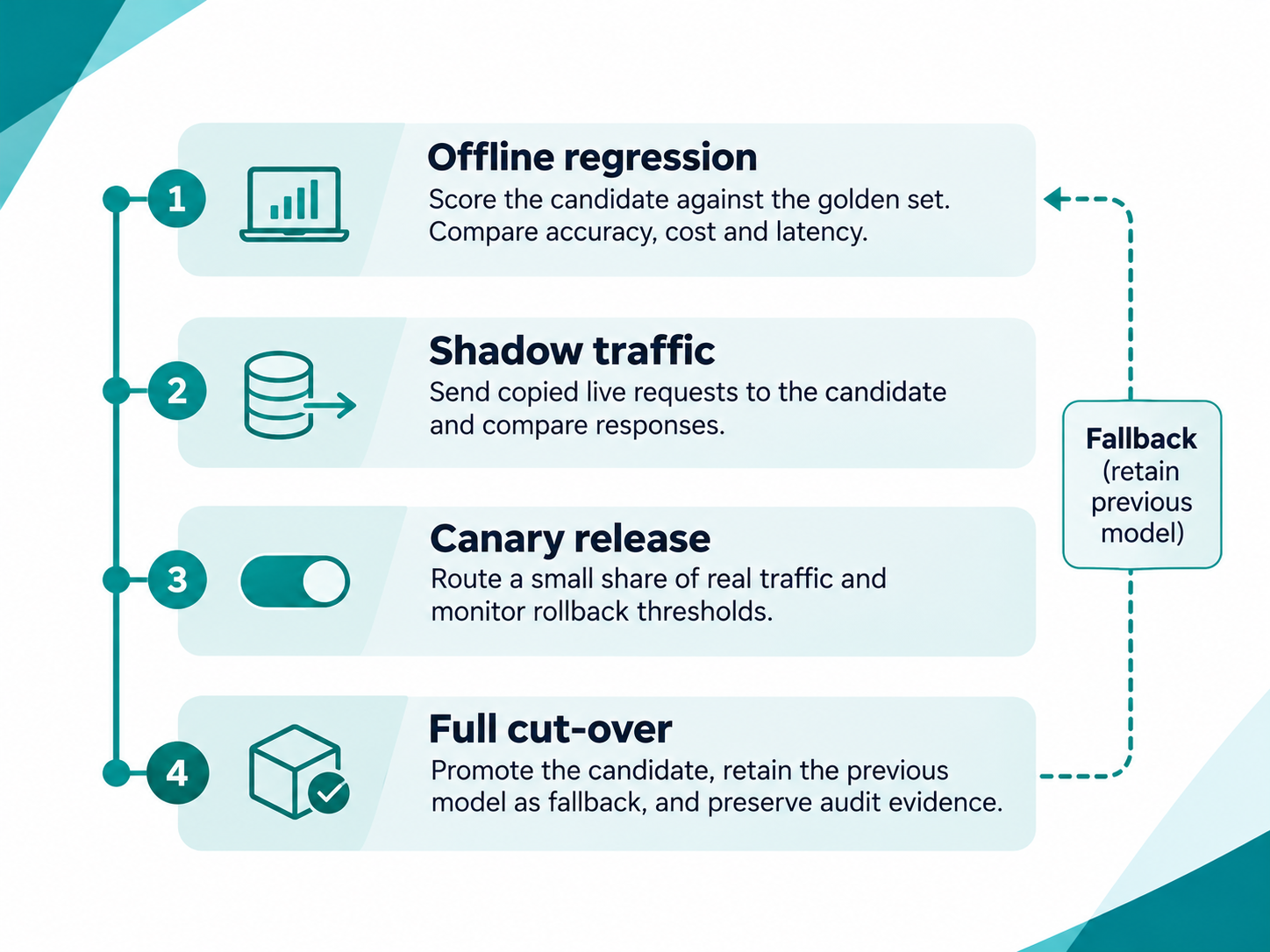
The process has four stages:
- Offline regression: Score the candidate against the golden evaluation set. Compare accuracy, cost per task and latency with the current baseline, and review every case where the outcome differs.
- Shadow traffic: Send a copy of live requests to the candidate model without acting on its output. Compare its responses and decisions with those of the production model.
- Canary release: Route a small share of real traffic to the candidate. Set automatic rollback conditions if quality or latency thresholds are breached.
- Full cut-over: Promote the candidate through configuration, retain the previous model as a fallback and preserve comparison results as audit evidence.
One caution applies to automated evaluation. Using one model to grade another is efficient, but it is not a substitute for human judgement on subjective criteria. Microsoft Research found that LLM judges reach only 58% to 66% of human-level agreement on subjective rubrics, even when they agree closely with each other. Automated judges should therefore be calibrated against a human-labelled sample before being trusted as a release gate. Read the research.
The same architecture also supports sovereignty and residency requirements. An open-weight model hosted within an organisation’s own environment can sit behind the gateway as another option, without requiring changes to the agents above it.
Getting Started: Building Model Flexibility One Agent at a Time
Building this capability does not require a large re-platforming programme. Enterprises can introduce it progressively, starting with the agents where model dependency creates the greatest business risk.
- Map the exposure. Inventory production agents and AI features, the model and version each depends on, and the business decision each supports. Flag applications where an outage could interrupt revenue or affect a regulated decision.
- Establish a baseline. For the most critical agent, build a golden evaluation set from real cases and record the current model’s accuracy, cost per task and latency.
- Introduce the gateway. Route that agent’s model calls through a single layer with schema validation, tracing and a fallback model. Move business rules out of prompts and into a managed context layer.
- Rehearse a switch. Take a second model through regression testing, shadow traffic and canary deployment. Measure the engineering effort required to make the change.
- Scale and contract. Apply the pattern to the next critical agent. Include model retirement notice periods, version pinning and exit terms in future provider agreements.
The objective is straightforward: every business-critical agent should be able to change models quickly, with documented evidence that its performance has been maintained.
How Eastern Enterprise Helps Build Model-Independent AI Systems
Earlier phases of digital transformation focused on selecting the right platform. In 2027, the advantage lies in adopting the best available AI model without disrupting the business. The most capable model next year may not exist yet. The organisations that benefit from it will be those whose architecture is ready to use it.
Eastern Enterprise’s Forward Deployed Engineers work alongside client teams to build this capability, from evaluation sets and managed context layers to model gateways, governance and switching rehearsals. They start with the business-critical decisions, then engineer the architecture that allows the underlying models to change without disrupting the systems around them.
The model may change. Your enterprise architecture should be ready for it.