
Most enterprises still carry an application estate that reflects how the business operated several years ago. A procurement tool configured around an approval chain that has since changed. A customer portal built for a product line that has evolved twice. A reporting application that three teams now export into spreadsheets because it no longer answers their questions.
Each application continues to carry licence fees, support contracts, integration maintenance and a backlog of change requests.
This is not necessarily a failure of planning. It is the consequence of a model in which software was expensive to build and therefore expected to last. Organisations bought or developed applications, then adapted their processes around them because replacing those systems was harder than continuing to maintain them.
That economic premise is changing. AI-assisted development and agentic tooling are reducing the time and effort required to produce working applications. Gartner has identified disposable applications as one of its strategic technology trends for 2027: purpose-built software designed to be retired when its specific business purpose has been fulfilled or is no longer relevant.
The implication for digital transformation is significant. If applications become faster and less expensive to create and replace, the durable assets are no longer the applications themselves. They are the data, context, integrations and business logic that applications depend on.
This article examines what that shift means, why many transformation programmes are not yet structured for it, and what organisations need to put in place to benefit from it.
How the economics of software are changing
For much of the past three decades, enterprise software decisions were governed by a simple constraint: building was slow and expensive, so whatever was built had to serve multiple purposes over many years. This encouraged large, general-purpose platforms, lengthy implementation programmes and extensive customisation.
It also created dependency, not only on vendors but on the assumptions and business processes embedded in each system when it was configured.
Three developments are loosening that constraint.
First, code generation has progressed beyond autocomplete towards producing complete, working applications. A business analyst working with an engineer can now describe an internal tool, review an initial generated version and refine it through conversation rather than relying entirely on lengthy specification cycles.
Second, integration is becoming more standardised. The Model Context Protocol (MCP), now governed through the Agentic AI Foundation under the Linux Foundation, provides a standardised way for AI applications to connect with external tools and data sources. This creates opportunities to develop reusable integration capabilities rather than rebuilding every connection for each application.
Third, AI agents are increasingly capable of performing work that previously required a dedicated user interface. Where a team once needed a screen to review, approve and route requests, an agent can now handle much of that workflow, presenting only the exceptions that require human judgement.
Together, these developments are making the application layer lighter and faster to change. The question for leadership teams is what becomes more important when individual applications are no longer expected to carry the organisation’s operating knowledge.
Why outgrown software persists
If replacing software is becoming easier, why do so many organisations continue to operate applications that no longer fit their needs?
In our experience, the answer is rarely the application itself. It is what has accumulated inside it.
Over years of use, enterprise applications absorb business rules, data definitions and process knowledge that often exist nowhere else. The logic determining which customers qualify for a discount, how a credit limit is calculated or which supplier is preferred in a particular region may live in configuration screens, custom fields and scripts written by people who have since moved on.
The application gradually becomes the only place where parts of the organisation’s operating knowledge are recorded.
This creates a dependency that can be more difficult to address than vendor lock-in. Retiring the application first requires extracting, understanding and validating everything it knows. That work is slow, risky and rarely funded as a separate initiative. So the application stays, and the organisation continues paying for software it has outgrown.
The same problem limits the promise of AI-generated applications. A new tool might be built in a week, but if the rules it must follow and the data it must use remain locked inside existing systems, it cannot be trusted with real business work. Speed at the application layer has limited value when the foundations beneath it remain inaccessible.
What becomes durable
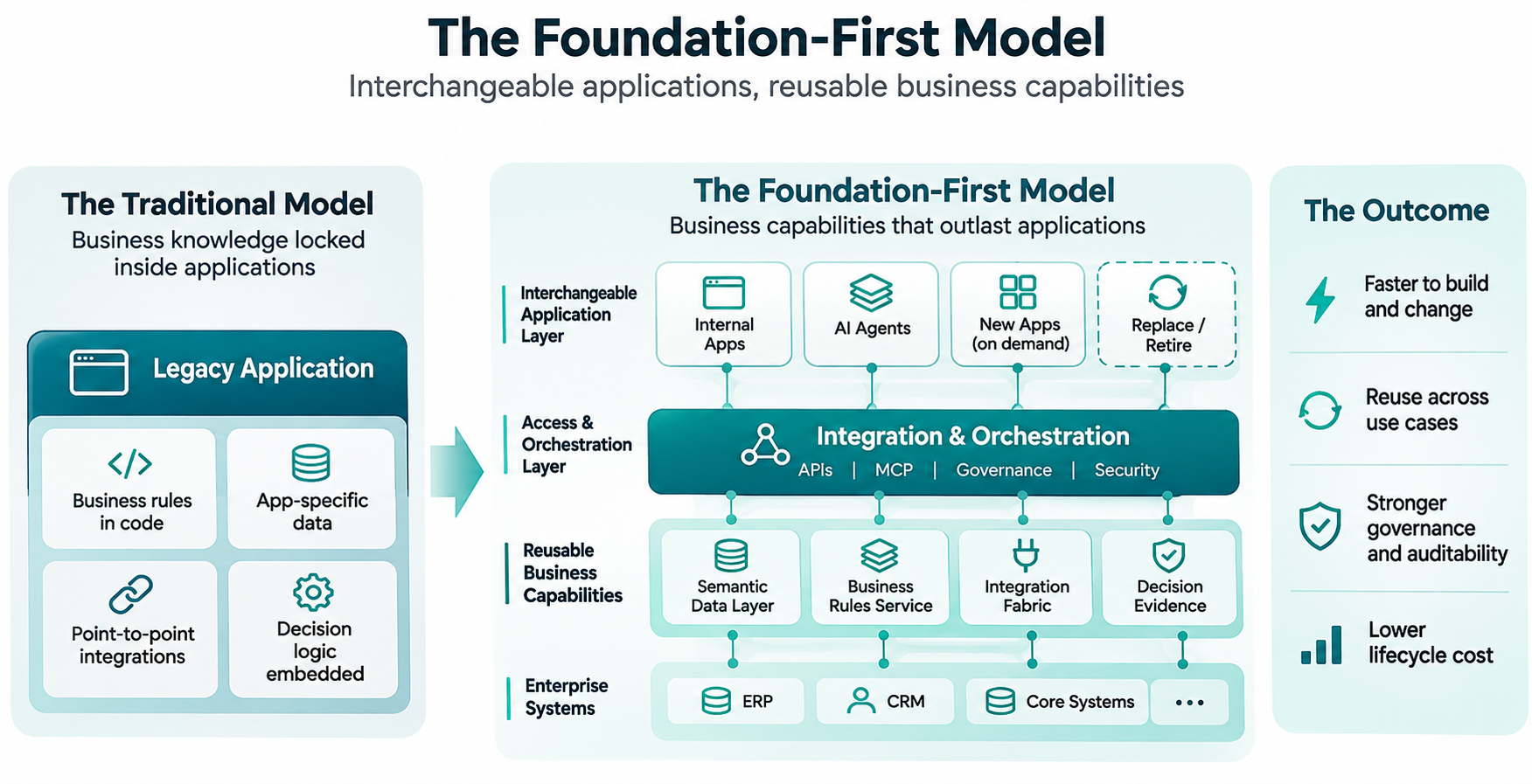
When applications become less expensive to build and replace, transformation investment needs to move towards the assets that outlast any individual application. We see four that matter most.
Data that carries its own meaning
Most enterprise data was organised to support reports and dashboards, where a human analyst supplies much of the interpretation. AI systems and generated applications cannot always rely on that human context.
They need data that carries agreed definitions with it: what counts as an active customer, how revenue is recognised, and which status codes indicate that a transaction is complete.
Gartner identifies AI context platforms as a strategic technology trend for 2027 and highlights the importance of semantic foundations for improving agentic AI accuracy and reducing costs.
In practical terms, this means establishing a governed semantic layer that defines business entities and metrics consistently, so every application and agent works from the same interpretation. This is a key part of building an effective enterprise Data & AI foundation.
Business rules held outside applications
Rules governing eligibility, pricing, approval thresholds and compliance obligations should be maintained in a form that is versioned, testable and independent of any single application.
When business rules are externalised, new applications can apply them without recreating the logic from scratch. Changes can also be managed and deployed more consistently across the systems that depend on them.
This is also where regulatory readiness becomes important. Under the EU AI Act, certain AI systems used to evaluate the creditworthiness of natural persons are classified as high-risk. Requirements relating to risk management, documentation, traceability and human oversight make it important to understand how automated decisions are reached.
Explicit, independently managed rules make it easier to inspect and demonstrate how a decision was produced than logic buried in application-specific code.
Integrations built once, used many times
Connections to core systems, whether an ERP, CRM or payment platform, should be designed as reusable, governed interfaces that authorised applications and agents can access.
Open standards such as MCP can help standardise how AI systems discover and interact with tools and data sources. However, standardisation does not remove the need for access controls, authentication, authorisation and integration governance.
The objective is to make secure access to core systems reusable. A newly generated application should be able to build on existing integration capabilities rather than waiting for an entirely separate integration project. This is where platform and integration architecture becomes a durable enterprise capability.
Evidence of how decisions are made
The fourth durable asset is evidence of how the organisation’s decisions are actually made.
This includes representative cases with known correct outcomes, together with records of what each application or agent did and why.
That evidence serves two purposes. First, it allows a new application to be tested against real business expectations before it is trusted with live work. Second, it creates an audit trail that supports internal risk management and the documentation and traceability expected in regulated environments.
What this means for digital transformation programmes
Traditional transformation programmes were often organised around applications: select a platform, implement it, migrate data into it and train users. Success was measured through go-live dates, deployment milestones and adoption rates.
In the model described here, the centre of gravity moves. Applications become the visible, frequently changing layer of a more stable foundation. Transformation success depends less on which systems have been deployed and more on how quickly an organisation can respond to a new requirement with a working, trustworthy tool.
This has several consequences for how programmes are structured.
- Portfolio decisions change. Rather than immediately asking which platform should replace an outgrown application, leadership teams need to identify which parts of its business knowledge must be extracted into durable foundations. Once that knowledge is accessible, the application can be retired or replaced with something lighter.
- Funding changes. Investment that previously went into large application implementation projects shifts towards semantic data layers, business rules management, integration standards and evaluation capabilities. These assets may be less visible than a new platform, but they support every application that follows.
- Ownership changes. When business rules and data definitions are maintained as shared assets, business teams take a more direct role in owning them. Technology teams focus on keeping the underlying foundation reliable, secure and accessible.
- Governance changes. If applications can be generated quickly, they can also proliferate quickly. Organisations need a clear process to register, review and retire applications and agents, with defined identities, permissions and accountable owners. Without this, the risk shifts from outgrown software to unmanaged software.
Questions leadership teams should be asking
For organisations assessing their readiness, the following questions can help identify where the real constraints lie.
- Which applications do we continue to maintain primarily because they contain business rules or data that we cannot easily extract?
- If a team needed a new internal tool next month, could it access governed data, current business rules and core system integrations without a separate project for each?
- Do our key business terms, such as customer, order and margin, have a single agreed definition that both people and AI systems use?
- For our most important automated decisions, could we demonstrate which rules were applied, what evidence informed the outcome and why the system reached its decision?
- Do we maintain a register of the applications and agents operating across the business, with an accountable owner for each?
Where the answers are uncertain, the priority is not necessarily a new platform. It is the foundation that will make every future platform, application and agent easier to build and safer to operate.
Where to begin
The transition does not require a wholesale transformation programme. In practice, it is often more effective to start with a specific, valuable use case and build the foundation outward from there.
- Select an outgrown application. Identify one system that carries significant cost or operational frustration. Map the business rules, data definitions and integrations it contains.
- Extract the business logic. Move the most important rules into a versioned, testable form and define the related data entities in a shared semantic layer.
- Build reusable integrations. Turn the connections the application relies on into governed interfaces, using open standards where appropriate.
- Establish an evaluation baseline. Assemble representative real-world cases with known correct outcomes. Use them to validate a lighter replacement before it handles live business work.
- Retire and repeat. Once the replacement has been validated and operationally adopted, retire the original application. Apply the same foundations to the next use case.
Each cycle leaves the organisation with more durable assets and fewer outgrown systems. Over time, responding to new requirements should take less effort because each new application can draw on foundations that already exist.
Conclusion
The enterprise software estate was shaped by a period in which applications were expensive to build and expected to last. That period is changing. As AI makes applications faster and less expensive to produce, the organisations that benefit most will be those that have separated their operating knowledge from the systems that currently hold it.
Digital transformation in 2027 is therefore less about choosing the next platform and more about building the foundation that makes applications interchangeable: data with shared meaning, business rules maintained as governed assets, reusable integrations and evidence of how decisions are made.
With that foundation in place, outgrown software becomes a choice rather than a constraint.
At Eastern Enterprise, our Forward Deployed Engineers work alongside client teams to build these foundations, starting with a high-value use case and extending the capabilities across the business.
Talk to Eastern Enterprise about your next transformation initiative.